Counterexamples and deductive reasoning worksheet – Grade 10
Questions at easy, medium and hard levels. Pick a level and get a fresh set every time, with instant feedback.
How to solve counterexamples and deductive reasoning questions
Learn it Inductive reasoning finds a pattern from examples, which may fail. Deductive reasoning uses true rules and always gives a true result. One counterexample is enough to prove a claim false, but no number of examples proves it true.
Example: "All primes are odd" is false: 2 is a prime and it is even.
- Read the claim
- Look for a case that fits the "if" part but not the "then" part
- From "if p, then q" and p, you may conclude q
- From "if p, then q" and q, you may not conclude p
Loading questions…
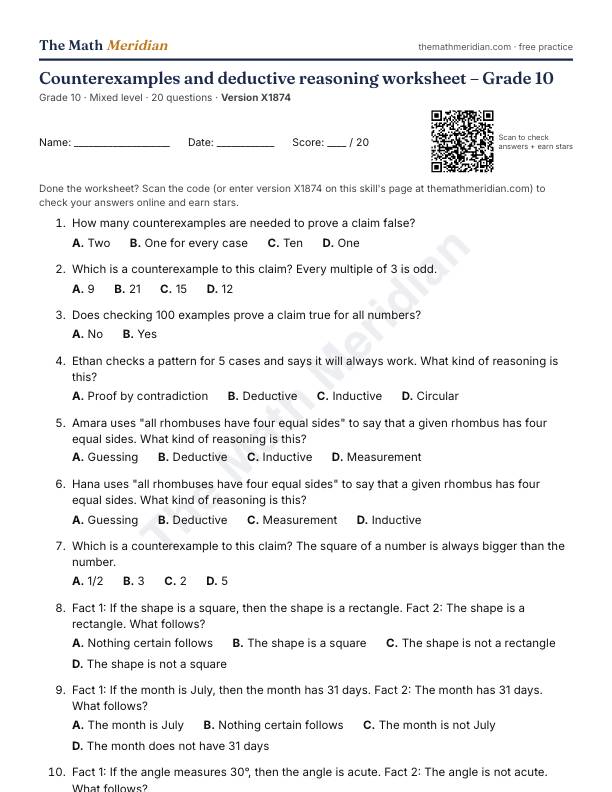
Free printable PDF: Counterexamples and deductive reasoning worksheet (Grade 10)
20 questions from easy to hard, with an answer key on the last page. Print it, then scan the QR code on the sheet to check the answers online and earn stars.
Download the PDF worksheetWant a different version? Use Printable worksheet above for a new set of questions every time.
Worked examples: Counterexamples and deductive reasoning
Try each one first, then open the solution.
-
Easy
Which is a counterexample to this claim? Adding 1 to a number and doubling always gives more than the number.
Choices: 3 · 5 · -4 · 8
Show the solution
Answer: -4
(−4 + 1) × 2 = −6, which is less than −4.
-
Medium
All members of the chess club are in Grade 5. Ben is in Grade 5. What follows?
Choices: Everyone in the grade plays chess · Nothing certain follows · Ben is in the chess club · Ben is not in the chess club
Show the solution
Answer: Nothing certain follows
The rule does not say all Grade 5 students are members.
-
Hard
A claim says that 2ⁿ > n² for all whole numbers n ≥ 1. Starting from n = 1, what is the first value of n that is a counterexample?
Show the solution
Answer: 2
n = 1: 2 > 1 holds. n = 2: 4 > 4 fails.