Linear systems in real life: reading graphs worksheet – Grade 10
Questions at easy, medium and hard levels. Pick a level and get a fresh set every time, with instant feedback.
How to solve linear systems in real life: reading graphs questions
Learn it When two quantities are each described by a straight line, the point where the lines cross is the solution of the system: the same x gives the same y on both. In real life it answers questions like when two plans cost the same, how many items must be sold to break even (revenue = cost), or when someone catches up.
Example: A club's cost is C = 60 + 2n and its revenue is R = 5n. How many items must it sell to break even?
- Set revenue equal to cost: 5n = 60 + 2n.
- 3n = 60
- n = 20. On the graph, the lines cross at n = 20.
Loading questions…
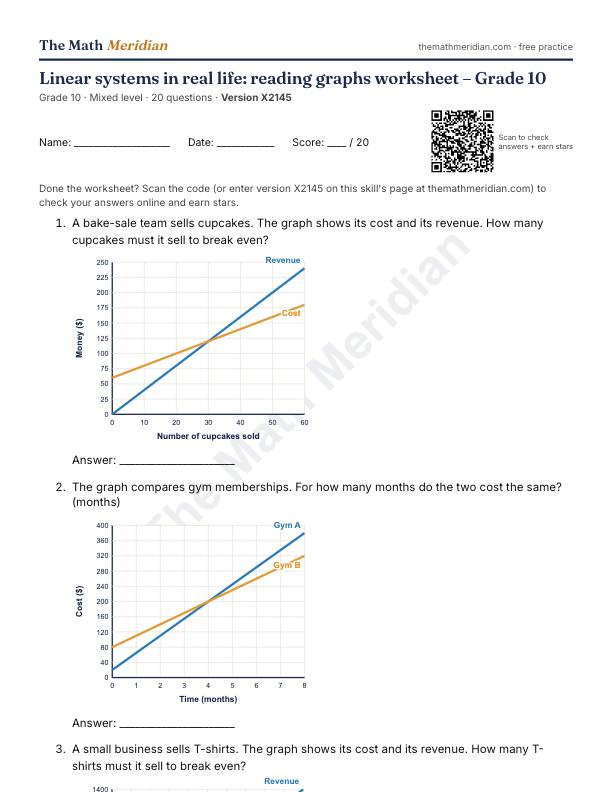
Free printable PDF: Linear systems in real life: reading graphs worksheet (Grade 10)
20 questions from easy to hard, with an answer key on the last page. Print it, then scan the QR code on the sheet to check the answers online and earn stars.
Download the PDF worksheetWant a different version? Use Printable worksheet above for a new set of questions every time.
Worked examples: Linear systems in real life: reading graphs
Try each one first, then open the solution.
-
Easy
A small business sells T-shirts. The graph shows its cost and its revenue. How many T-shirts must it sell to break even?
Show the solution
Answer: 30
Break-even is where the two lines cross, so revenue equals cost. They cross at 30 T-shirts ($420). Check: 14 × 30 = 240 + 6 × 30 = 420.
-
Medium
Mateo leaves home walking at a steady speed. Ben leaves the same place 2 h later on a bike, along the same path. How far from home are they when Ben catches up? (km)
Show the solution
Answer: 12
The lines cross at (3, 12): Ben catches up 12 km from home.
-
Hard
The graph compares poster printing (C is the cost and n is the number of posters). Which system of equations matches the graph?
Choices: $C = 4n + 20$ and $C = 2n + 16$ · $C = 4n + 10$ and $C = 2n + 16$ · $C = 2n + 10$ and $C = 4n + 16$ · $C = 4n + 16$ and $C = 2n + 10$
Show the solution
Answer: $C = 4n + 10$ and $C = 2n + 16$
Each line starts at its fixed fee (10 and 16) and rises by its rate (4 and 2 per poster).