Combining functions: sums, differences, products and quotients worksheet – Grade 12
Questions at easy, medium and hard levels. Pick a level and get a fresh set every time, with instant feedback.
How to solve combining functions: sums, differences, products and quotients questions
Learn it (f + g)(x) = f(x) + g(x), (f − g)(x) = f(x) − g(x), (f·g)(x) = f(x)·g(x), (f/g)(x) = f(x) ÷ g(x). The domain of a combined function is where both f and g are defined; for f/g, also leave out every x with g(x) = 0.
Example: f(x) = √(x − 2) and g(x) = x − 5. What is the domain of (f/g)(x)?
- f needs x ≥ 2.
- g(x) = 0 at x = 5, which must be left out.
- x ≥ 2, x ≠ 5.
Loading questions…
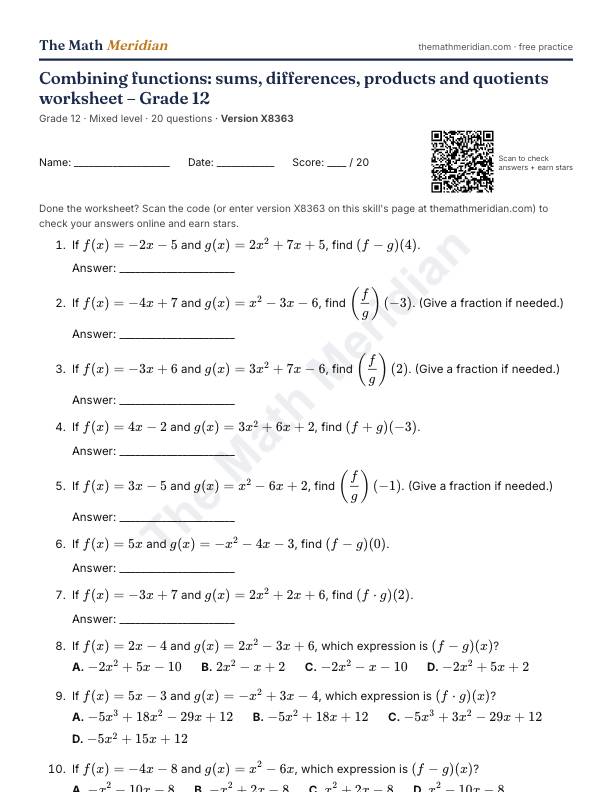
Free printable PDF: Combining functions: sums, differences, products and quotients worksheet (Grade 12)
20 questions from easy to hard, with an answer key on the last page. Print it, then scan the QR code on the sheet to check the answers online and earn stars.
Download the PDF worksheetWant a different version? Use Printable worksheet above for a new set of questions every time.
Worked examples: Combining functions: sums, differences, products and quotients
Try each one first, then open the solution.
-
Easy
If $f(x) = 4x + 1$ and $g(x) = 3x^2 - 2x + 3$, find $(f \cdot g)(-3)$.
Show the solution
Answer: -396
f(−3) = −11 and g(−3) = 36, so the answer is −11 × 36 = −396.
-
Medium
If $f(x) = 3x - 1$ and $g(x) = -x^2 + 6x - 1$, which expression is $(f \cdot g)(x)$?
Choices: $-3x^2 + 19x + 1$ · $-3x^2 + 18x + 1$ · $-3x^3 + x^2 - 9x + 1$ · $-3x^3 + 19x^2 - 9x + 1$
Show the solution
Answer: $-3x^3 + 19x^2 - 9x + 1$
Multiply each term of f by each term of g and collect like terms: −3x^3 + 19x^2 − 9x + 1.
-
Hard
If $f(x) = \log_2 x$ and $g(x) = 3x - 7$, find $f(g(3))$.
Show the solution
Answer: 1
g(3) = 2, and log₂ 2 = 1.
🧰 Try it hands-on: Meridian Graph. Graph it on our free graphing calculator and drag the sliders to see how it changes.