The cross product, areas and volumes worksheet – Grade 12
Questions at easy, medium and hard levels. Pick a level and get a fresh set every time, with instant feedback.
How to solve cross product, areas and volumes questions
Learn it u × v = [u₂v₃ − u₃v₂, u₃v₁ − u₁v₃, u₁v₂ − u₂v₁]. It is perpendicular to both u and v, and |u × v| = |u||v| sin θ is the area of the parallelogram they make (half of it is the triangle). v × u = −(u × v). The volume of the box (parallelepiped) on u, v and w is |u · (v × w)|.
Example: Find [1, 2, 0] × [3, 1, 4].
- x: 2×4 − 0×1 = 8.
- y: 0×3 − 1×4 = −4.
- z: 1×1 − 2×3 = −5. [8, −4, −5].
Loading questions…
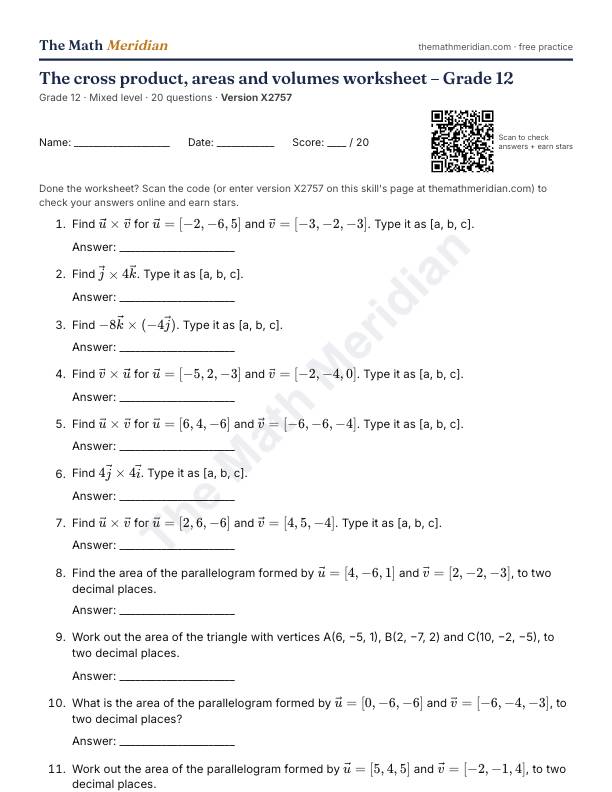
Free printable PDF: The cross product, areas and volumes worksheet (Grade 12)
20 questions from easy to hard, with an answer key on the last page. Print it, then scan the QR code on the sheet to check the answers online and earn stars.
Download the PDF worksheetWant a different version? Use Printable worksheet above for a new set of questions every time.
Worked examples: The cross product, areas and volumes
Try each one first, then open the solution.
-
Easy
Find $\vec{u} \times \vec{v}$ for $\vec{u} = [0, 2, 6]$ and $\vec{v} = [-2, 5, 6]$. Type it as [a, b, c].
Show the solution
Answer: [-18, -12, 4]
u × v = [(2)(6) − (6)(5), (6)(−2) − (0)(6), (0)(5) − (2)(−2)] = [−18, −12, 4].
-
Medium
What is the area of the triangle with vertices A(5, 0, 1), B(10, −1, 7) and C(8, −4, 0), to two decimal places?
Show the solution
Answer: 18.99
AB = [5, −1, 6], AC = [3, −4, −1], AB × AC = [25, 23, −17]. Area = ½|AB × AC| = ½√1443 ≈ 18.99 square units.
-
Hard
A 94 N force is applied to a wrench 71 cm long, at 56° to the wrench. Find the magnitude of the torque, in N·m, to one decimal place.
Show the solution
Answer: 55.3
|τ| = |r × F| = |r||F| sin θ = 0.71 × 94 × sin 56° ≈ 55.3 N·m.