Finite differences and families of polynomial functions worksheet – Grade 12
Questions at easy, medium and hard levels. Pick a level and get a fresh set every time, with instant feedback.
How to solve finite differences and families of polynomial functions questions
Learn it For a polynomial of degree n, the nth finite differences (with equal steps in x) are constant, and equal a × n! when the step is 1 (a is the leading coefficient). A family of polynomials with zeros r₁, r₂, … is y = k(x − r₁)(x − r₂)…; one point on the graph fixes k.
Example: A cubic has zeros −1, 2 and 3 and passes through (0, 12). Find k.
- y = k(x + 1)(x − 2)(x − 3).
- At x = 0: 12 = k(1)(−2)(−3) = 6k.
- k = 2.
Loading questions…
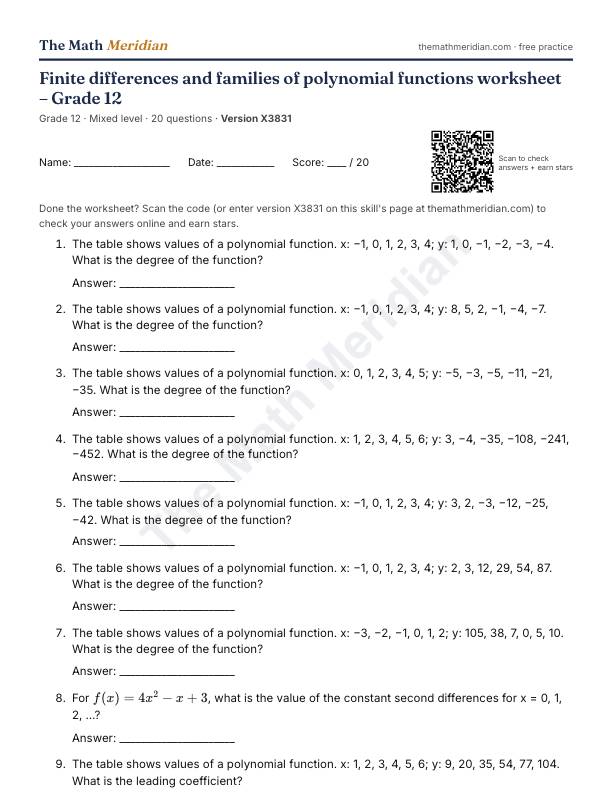
Free printable PDF: Finite differences and families of polynomial functions worksheet (Grade 12)
20 questions from easy to hard, with an answer key on the last page. Print it, then scan the QR code on the sheet to check the answers online and earn stars.
Download the PDF worksheetWant a different version? Use Printable worksheet above for a new set of questions every time.
Worked examples: Finite differences and families of polynomial functions
Try each one first, then open the solution.
-
Easy
The table shows values of a polynomial function. x: −1, 0, 1, 2, 3, 4; y: 7, 0, −1, 4, 15, 32. What is the degree of the function?
Show the solution
Answer: 2
The second differences are constant (6), so the degree is 2.
-
Medium
The table shows values of a polynomial function. x: 0, 1, 2, 3, 4, 5; y: −5, −6, −7, −8, −9, −10. What is the leading coefficient?
Show the solution
Answer: -1
The first differences are constant at −1. Leading coefficient = −1 ÷ 1! = −1.
-
Hard
A polynomial function has zeros 1, −4, −2, 2 and no others, is of degree 4, and its graph passes through (5, −2268). If $y = k(x - 1)(x + 4)(x + 2)(x - 2)$, what is k?
Show the solution
Answer: -3
Substitute x = 5: −2268 = k × 756, so k = −3.
🧰 Try it hands-on: Meridian Graph. Graph it on our free graphing calculator and drag the sliders to see how it changes.