Intersections of lines and planes worksheet – Grade 12
Questions at easy, medium and hard levels. Pick a level and get a fresh set every time, with instant feedback.
How to solve intersections of lines and planes questions
Learn it To find where a line meets a plane, substitute the line's parametric equations into the plane's equation and solve for t. If the direction vector is perpendicular to the normal (d · n = 0), the line is parallel to the plane: it either misses it or lies in it. Three planes usually meet at one point: solve the three equations together.
Example: Where does [x, y, z] = [1, 0, 2] + t[1, 2, −1] meet x + y + z − 9 = 0?
- (1 + t) + 2t + (2 − t) − 9 = 0.
- 2t − 6 = 0, so t = 3.
- The point is (4, 6, −1).
Loading questions…
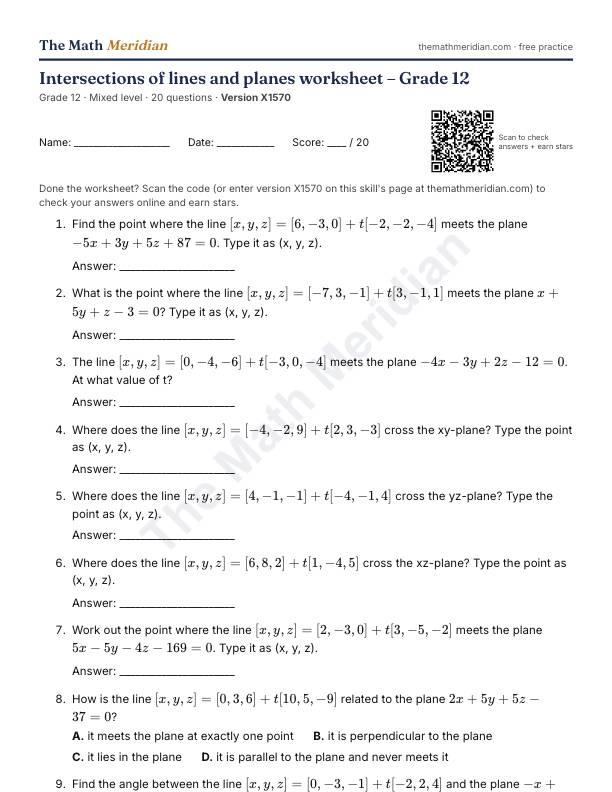
Free printable PDF: Intersections of lines and planes worksheet (Grade 12)
20 questions from easy to hard, with an answer key on the last page. Print it, then scan the QR code on the sheet to check the answers online and earn stars.
Download the PDF worksheetWant a different version? Use Printable worksheet above for a new set of questions every time.
Worked examples: Intersections of lines and planes
Try each one first, then open the solution.
-
Easy
Work out the point where the line $[x, y, z] = [2, -3, 0] + t[3, -5, -2]$ meets the plane $5x - 5y - 4z - 169 = 0$. Type it as (x, y, z).
Show the solution
Answer: (11, -18, -6)
Substituting gives −144 + 48t = 0, so t = 3 and the point is (11, −18, −6).
-
Medium
How is the line $[x, y, z] = [5, 2, 4] + t[-1, 5, 3]$ related to the plane $-x - 2y + 4z + 8 = 0$?
Choices: it is parallel to the plane and never meets it · it is perpendicular to the plane · it lies in the plane · it meets the plane at exactly one point
Show the solution
Answer: it meets the plane at exactly one point
d · n = 3, which isn't 0, so the line crosses the plane once.
-
Hard
What is the distance from (−4, 4, 5) to the line $[x, y, z] = [-5, -5, 1] + t[-4, 3, 4]$, to two decimal places?
Show the solution
Answer: 7.80
Let w = (−4, 4, 5) − (−5, −5, 1) = [1, 9, 4]. Distance = |w × d| ÷ |d| = √2497 ÷ √41 ≈ 7.80.