Area ratios: parallel lines and midpoints worksheet – Grade 8
Questions at easy, medium and hard levels. Pick a level and get a fresh set every time, with instant feedback.
How to solve area ratios: parallel lines and midpoints questions
Learn it If DE is parallel to BC, then △ADE ~ △ABC. Use AD : AB, not AD : DB, then square it. The part left over is the whole area minus the small triangle.
Example: AD : DB = 2 : 1 and the area of △ADE is 16.
- AD : AB = 2 : 3.
- Areas are 4 : 9, so one part is 4 and △ABC = 36.
- The part DECB = 36 − 16 = 20.
Loading questions…
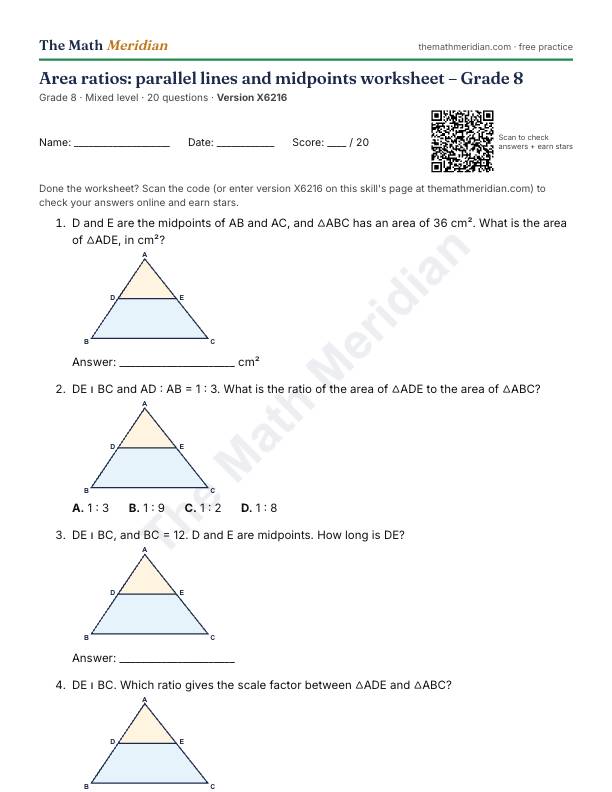
Free printable PDF: Area ratios: parallel lines and midpoints worksheet (Grade 8)
20 questions from easy to hard, with an answer key on the last page. Print it, then scan the QR code on the sheet to check the answers online and earn stars.
Download the PDF worksheetWant a different version? Use Printable worksheet above for a new set of questions every time.
Worked examples: Area ratios: parallel lines and midpoints
Try each one first, then open the solution.
-
Easy
D and E are the midpoints of AB and AC. What fraction of △ABC is △ADE?
Choices: 1/3 · 1/2 · 1/8 · 1/4
Show the solution
Answer: 1/4
The side ratio is 1 : 2, so areas are 1 : 4.
-
Medium
DE ∥ BC with AD : DB = 5 : 2. △ADE has an area of 100 cm². What is the area of the trapezoid DECB, in cm²?
Show the solution
Answer: 96
△ABC = 196. 196 − 100 = 96.
-
Hard
M, N and P are the midpoints of the sides of △ABC, which has an area of 48 cm². What is the area of △MNP, in cm²?
Show the solution
Answer: 12
The midpoints cut △ABC into 4 congruent triangles: 48 ÷ 4 = 12.
Area ratios with parallel lines and midpoints: questions parents ask
Why does a parallel line make similar triangles?
A line drawn parallel to one side of a triangle cuts off a smaller triangle with the same three angles as the original (corresponding angles are equal), so the two triangles are similar.
How do you find the area ratio when a line is parallel to one side?
Find the ratio of matching sides of the small and large triangles, then square it. If DE is parallel to BC and AD : AB = 2 : 5, then the area of triangle ADE : area of triangle ABC = 4 : 25, so the trapezoid DECB is the other 21 parts.
What happens when you join the midpoints of two sides?
The segment joining the midpoints is parallel to the third side and half as long (the midpoint theorem). The small triangle has sides half as long, so its area is (1/2)² = 1/4 of the whole triangle, and the trapezoid left over is 3/4.
What if you join all three midpoints?
You get four congruent triangles, each with one quarter of the area of the original triangle.
What is the most common mistake?
Using AD : DB instead of AD : AB. The two triangles being compared are ADE and ABC, so the side ratio must use the whole side AB.
Where can my child review the basic rule?
Start with the ratio of areas of similar triangles: if the sides are in the ratio a : b, the areas are in the ratio a² : b².