Transformations of y = x²: shifts, stretches and reflections worksheet – Grade 11
Questions at easy, medium and hard levels. Pick a level and get a fresh set every time, with instant feedback.
How to solve transformations of y = x²: shifts, stretches and reflections questions
Learn it In y = a[k(x − d)]² + c each letter does one job. a: vertical stretch (|a| > 1) or compression (|a| < 1); a < 0 also reflects in the x-axis. k: horizontal compression by 1/k (k > 1) or stretch (k < 1). d: moves the graph right (left if d is negative). c: moves it up (down if c is negative). The vertex moves from (0, 0) to (d, c), and any point (x, y) on y = x² moves to (x/k + d, ay + c).
Example: Describe y = −2[½(x + 3)]² + 5 and find the image of (2, 4).
- a = −2: vertical stretch by 2 and a reflection in the x-axis.
- k = ½: horizontal stretch by a factor of 2.
- d = −3, c = 5: 3 left and 5 up. The vertex is (−3, 5).
- (2, 4) → (2 ÷ ½ − 3, −2 × 4 + 5) = (1, −3).
Loading questions…
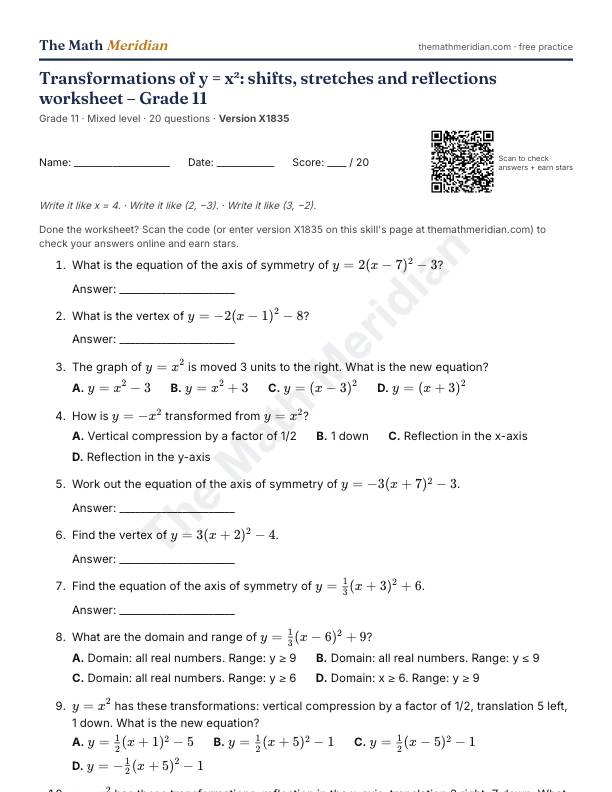
Free printable PDF: Transformations of y = x²: shifts, stretches and reflections worksheet (Grade 11)
20 questions from easy to hard, with an answer key on the last page. Print it, then scan the QR code on the sheet to check the answers online and earn stars.
Download the PDF worksheetWant a different version? Use Printable worksheet above for a new set of questions every time.
Worked examples: Transformations of y = x²: shifts, stretches and reflections
Try each one first, then open the solution.
-
Easy
How is $y = (3x)^2$ transformed from $y = x^2$?
Choices: Horizontal compression by a factor of 1/3 · Horizontal stretch by a factor of 3 · Vertical compression by a factor of 1/3 · 3 left
Show the solution
Answer: Horizontal compression by a factor of 1/3
k = 3 is inside the bracket with x, so it acts horizontally by 1/3: a horizontal compression.
-
Medium
Which describes how $y = -(x - 1)^2 + 4$ is transformed from $y = x^2$?
Choices: Translation 1 right, 4 up · Reflection in the x-axis, translation 1 left, 4 up · Reflection in the x-axis, translation 4 right, 1 up · Reflection in the x-axis, translation 1 right, 4 up
Show the solution
Answer: Reflection in the x-axis, translation 1 right, 4 up
The negative sign in front reflects the graph in the x-axis. (x − 1) moves the graph 1 right (the opposite of the sign you see). + 4 at the end moves it 4 up.
-
Hard
Which describes how $y = -\left[\tfrac{1}{2}(x + 1)\right]^2 - 2$ is transformed from $y = x^2$?
Choices: Reflection in the x-axis, horizontal stretch by a factor of 2, translation 1 right, 2 down · Horizontal stretch by a factor of 2, translation 1 left, 2 down · Reflection in the x-axis, horizontal compression by a factor of 1/2, translation 1 left, 2 down · Reflection in the x-axis, horizontal stretch by a factor of 2, translation 1 left, 2 down
Show the solution
Answer: Reflection in the x-axis, horizontal stretch by a factor of 2, translation 1 left, 2 down
The negative sign in front reflects the graph in the x-axis. k = 1/2 acts on the x-values by 1/k: a horizontal stretch by a factor of 2. (x + 1) moves the graph 1 left (the opposite of the sign you see). − 2 at the end moves it 2 down.
🧰 Try it hands-on: Meridian Graph. Graph it on our free graphing calculator and drag the sliders to see how it changes.