Rates of change, optimization and related rates worksheet – Grade 12
Questions at easy, medium and hard levels. Pick a level and get a fresh set every time, with instant feedback.
How to solve rates of change, optimization and related rates questions
Learn it Velocity is s′(t) and acceleration is s″(t); an object is at rest when v(t) = 0. To optimize, write the quantity as a function of one variable, find where its derivative is 0, and check the endpoints. Related rates: write an equation linking the quantities, differentiate both sides with respect to time t, then substitute.
Example: A farmer has 200 m of fence for a rectangle along a river (no fence on the river side). What is the largest area?
- Let the sides touching the river be x: the third side is 200 − 2x.
- A(x) = x(200 − 2x), A′(x) = 200 − 4x = 0 at x = 50.
- A(50) = 50 × 100 = 5000 m².
Loading questions…
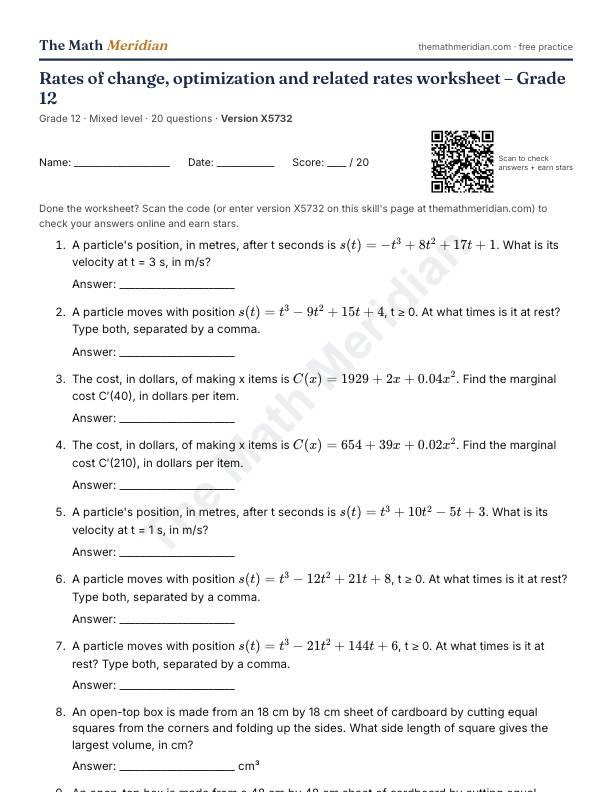
Free printable PDF: Rates of change, optimization and related rates worksheet (Grade 12)
20 questions from easy to hard, with an answer key on the last page. Print it, then scan the QR code on the sheet to check the answers online and earn stars.
Download the PDF worksheetWant a different version? Use Printable worksheet above for a new set of questions every time.
Worked examples: Rates of change, optimization and related rates
Try each one first, then open the solution.
-
Easy
A particle moves with position $s(t) = t^3 - 15t^2 + 27t + 19$, t ≥ 0. At what times is it at rest? Type both, separated by a comma.
Show the solution
Answer: 1,9
v(t) = 3t^2 − 30t + 27 = 3(t − 1)(t − 9) = 0 at t = 1 s and t = 9 s.
-
Medium
At a price of p dollars, a store sells $q = 280 - 5p$ items a week. What price gives the greatest weekly revenue, in dollars?
Show the solution
Answer: 28
Revenue R(p) = p(280 − 5p) = 280p − 5p². R′(p) = 280 − 10p = 0 at p = 28 dollars (weekly revenue 3,920 dollars).
-
Hard
A circular ripple spreads so that its radius grows at 0.5 cm/s. How fast is the area growing when the radius is 39 cm, in cm²/s, to one decimal place?
Show the solution
Answer: 122.5
A = πr², so dA/dt = 2πr · dr/dt = 2π(39)(0.5) ≈ 122.5 cm²/s.