Second derivatives, concavity and points of inflection worksheet – Grade 12
Questions at easy, medium and hard levels. Pick a level and get a fresh set every time, with instant feedback.
How to solve second derivatives, concavity and points of inflection questions
Learn it The second derivative f″(x) is the derivative of f′(x). Where f″(x) > 0 the graph is concave up (it bends upward, like a cup); where f″(x) < 0 it is concave down. A point of inflection is where the concavity changes. At a critical number c (f′(c) = 0): f″(c) > 0 means a local minimum, f″(c) < 0 means a local maximum, and f″(c) = 0 means the test doesn't decide. For motion, s″(t) is acceleration.
Example: Find the point of inflection of f(x) = x³ − 6x² + 5.
- f′(x) = 3x² − 12x, f″(x) = 6x − 12.
- f″(x) = 0 at x = 2, and f″ changes sign there.
- f(2) = 8 − 24 + 5 = −11, so the point of inflection is (2, −11).
Loading questions…
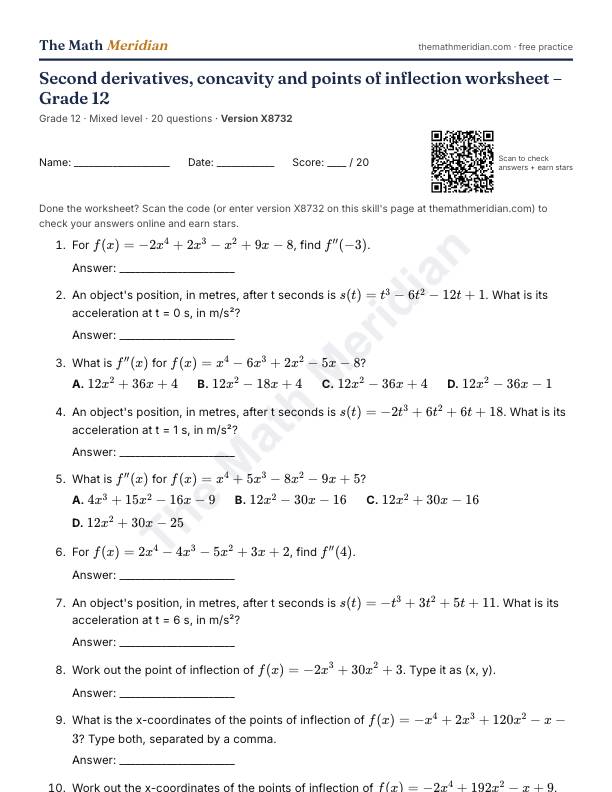
Free printable PDF: Second derivatives, concavity and points of inflection worksheet (Grade 12)
20 questions from easy to hard, with an answer key on the last page. Print it, then scan the QR code on the sheet to check the answers online and earn stars.
Download the PDF worksheetWant a different version? Use Printable worksheet above for a new set of questions every time.
Worked examples: Second derivatives, concavity and points of inflection
Try each one first, then open the solution.
-
Easy
What is $f''(x)$ for $f(x) = -2x^4 + x^3 + 6x^2 - 3x - 5$?
Choices: $-24x^2 + 6x + 12$ · $-24x^2 + 6x + 9$ · $-8x^3 + 3x^2 + 12x - 3$ · $-24x^2 - 6x + 12$
Show the solution
Answer: $-24x^2 + 6x + 12$
Differentiate twice: f′(x) = −8x^3 + 3x^2 + 12x − 3, then f″(x) = −24x^2 + 6x + 12.
-
Medium
Describe the concavity of $f(x) = 2x^3 - 24x^2 + 5x - 1$.
Choices: concave up for x > 4, concave down for x < 4 · concave up for x < 4, concave down for x > 4 · concave down for all x · concave up for all x
Show the solution
Answer: concave up for x > 4, concave down for x < 4
f″(x) = 12x − 48, which is 0 at x = 4 and positive for x > 4. So the graph is concave up for x > 4, concave down for x < 4.
-
Hard
$f(x) = 2x^3 - 54x - 7$ has a critical number at x = 3. Use the second derivative test to classify it.
Choices: a local minimum, because f″(3) = 36 > 0 · a point of inflection, because f′(3) = 0 · the test can't decide, because f″(3) = 0 · a local maximum, because f″(3) = 36 > 0
Show the solution
Answer: a local minimum, because f″(3) = 36 > 0
f″(x) = 12x, so f″(3) = 36. Concave up at a critical number means a local minimum.