Sinusoidal models in radians: tides and Ferris wheels worksheet – Grade 12
Questions at easy, medium and hard levels. Pick a level and get a fresh set every time, with instant feedback.
How to solve sinusoidal models in radians: tides and Ferris wheels questions
Learn it For h = a sin(k(t − d)) + c: amplitude |a|, period 2π ÷ k, phase shift d (to the right), axis h = c, maximum c + |a| and minimum c − |a|. A Ferris wheel that you board at the bottom follows h = −r cos(2πt ÷ P) + (centre height). To find when a height is reached, isolate the sine or cosine and use the special angles or the inverse function.
Example: The depth of water at a harbour is h = 2 sin(π/6 (t − 3)) + 5 metres, t hours after midnight. Find the period and the first high tide.
- Period = 2π ÷ (π/6) = 12 hours.
- A maximum happens when π/6 (t − 3) = π/2, so t − 3 = 3.
- The first high tide is at t = 6, which is 6:00 a.m., with depth 2 + 5 = 7 m.
Loading questions…
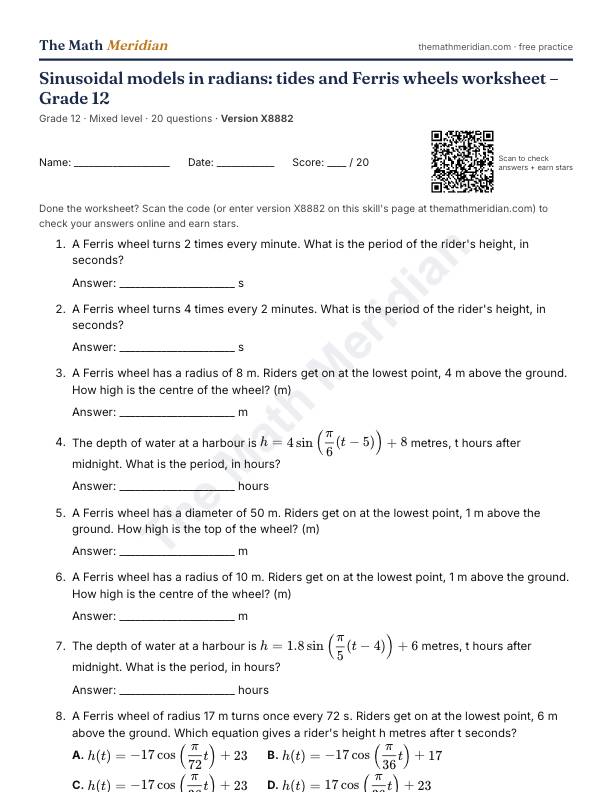
Free printable PDF: Sinusoidal models in radians: tides and Ferris wheels worksheet (Grade 12)
20 questions from easy to hard, with an answer key on the last page. Print it, then scan the QR code on the sheet to check the answers online and earn stars.
Download the PDF worksheetWant a different version? Use Printable worksheet above for a new set of questions every time.
Worked examples: Sinusoidal models in radians: tides and Ferris wheels
Try each one first, then open the solution.
-
Easy
The depth of water at a harbour is $h = 1.8\sin\left(\frac{\pi}{8}(t - 4)\right) + 5.2$ metres, t hours after midnight. What is the range of the function?
Choices: −1.8 ≤ h ≤ 1.8 · 3.4 ≤ h ≤ 7 · 1.6 ≤ h ≤ 8.8 · 4 ≤ h ≤ 20
Show the solution
Answer: 3.4 ≤ h ≤ 7
The axis is h = 5.2 and the amplitude is 1.8, so h goes from 5.2 − 1.8 = 3.4 to 5.2 + 1.8 = 7.
-
Medium
The depth of water at a harbour is $h = 1.5\sin\left(\frac{\pi}{5}(t - 5)\right) + 6$ metres, t hours after midnight. At what times between midnight and midnight is the water deepest, and how deep is it then?
Choices: 7:30 a.m. and 5:30 p.m., 7.5 m · 7:30 a.m. and 5:30 p.m., 6 m · 5:00 a.m. and 3:00 p.m., 7.5 m · 2:30 a.m. and 12:30 p.m. and 10:30 p.m., 7.5 m
Show the solution
Answer: 7:30 a.m. and 5:30 p.m., 7.5 m
The maximum, 6 + 1.5 = 7.5 m, happens when π/5 (t − 5) = π/2 + 2nπ, so t = 5 + 2.5 + 10n. In one day: t = 7.5, t = 17.5, which is 7:30 a.m. and 5:30 p.m.
-
Hard
For $d = 8\sin\left(\frac{\pi}{8}(t - 6)\right) + 4$, find every value of t in the cycle $6 \le t \le 22$ where d = 12. Give exact answers.
Choices: t = −2 · t = 10 · t = 18 · t = 4
Show the solution
Answer: t = 10
8 sin(π/8(t − 6)) + 4 = 12, so sin(π/8(t − 6)) = 1. In one cycle the angle is π/2. Multiply by 8/π and add 6: t = 10.
🧰 Try it hands-on: Meridian Graph. Graph it on our free graphing calculator and drag the sliders to see how it changes.