Mean absolute deviation (MAD) worksheet – Grade 6
Questions at easy, medium and hard levels. Pick a level and get a fresh set every time, with instant feedback.
How to solve mean absolute deviation (MAD) questions
Learn it The mean absolute deviation (MAD) shows how spread out data is. Find the mean, then how far each value is from the mean (always positive), then the mean of those distances. A small MAD means the values are close together.
Example: Find the MAD of 4, 6, 9, 13.
- Mean = (4 + 6 + 9 + 13) ÷ 4 = 32 ÷ 4 = 8.
- Distances from 8: 4, 2, 1, 5.
- MAD = (4 + 2 + 1 + 5) ÷ 4 = 12 ÷ 4 = 3.
Loading questions…
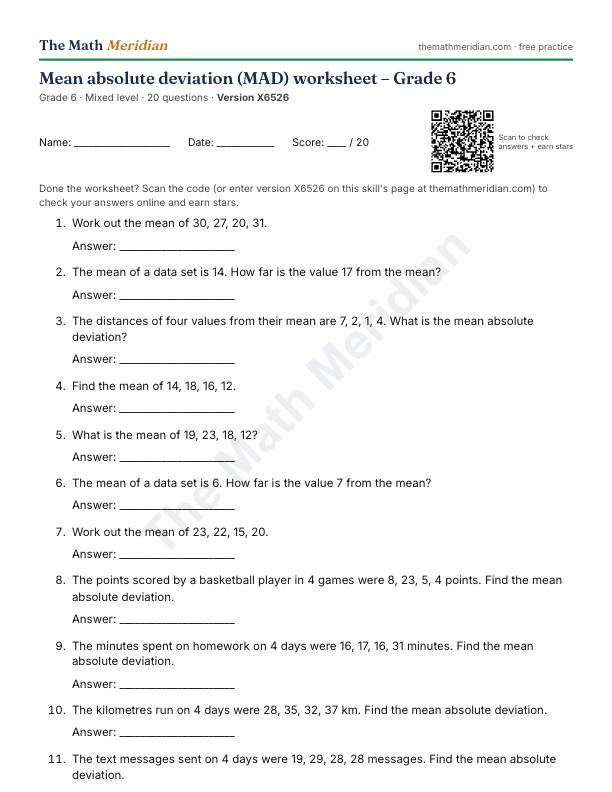
Free printable PDF: Mean absolute deviation (MAD) worksheet (Grade 6)
20 questions from easy to hard, with an answer key on the last page. Print it, then scan the QR code on the sheet to check the answers online and earn stars.
Download the PDF worksheetWant a different version? Use Printable worksheet above for a new set of questions every time.
Worked examples: Mean absolute deviation (MAD)
Try each one first, then open the solution.
-
Easy
The distances of four values from their mean are 1, 2, 6, 3. What is the mean absolute deviation?
Show the solution
Answer: 3
The MAD is the mean of the distances: (1 + 2 + 6 + 3) ÷ 4 = 12 ÷ 4 = 3.
-
Medium
The points scored by a basketball player in 5 games were 14, 23, 17, 17, 24 points. Find the mean absolute deviation.
Show the solution
Answer: 3.6
Mean = (14 + 23 + 17 + 17 + 24) ÷ 5 = 95 ÷ 5 = 19. Distances from the mean: 5, 4, 2, 2, 5. MAD = (5 + 4 + 2 + 2 + 5) ÷ 5 = 18 ÷ 5 = 3.6.
-
Hard
The minutes spent on homework on 5 days were 23, 9, 9, 17, 17 minutes, with mean 15 and MAD 4.8. A sixth value of 15 is added. What happens to the MAD?
Choices: It gets smaller · It stays the same · It gets larger
Show the solution
Answer: It gets smaller
The new value is 0 away from the mean, so the mean stays 15 and the total distance stays 24. Dividing by 6 instead of 5 gives 4, which is smaller.