Bank accounts: deposits, withdrawals and balances worksheet – Grade 7
Questions at easy, medium and hard levels. Pick a level and get a fresh set every time, with instant feedback.
How to solve bank accounts: deposits, withdrawals and balances questions
Learn it A deposit adds money and a withdrawal takes money out. The balance is what is in the account after each line. Overdrawn means the balance is below zero, so it is negative. Simple interest for a year is the balance × the rate.
Example: Balance $\$120{,}$ withdraw $\$150$: 120 − 150 = −$\$30{,}$ so the account is overdrawn by $\$30$.
- Start from the opening balance
- Add deposits
- Subtract withdrawals and fees
- Work line by line
Loading questions…
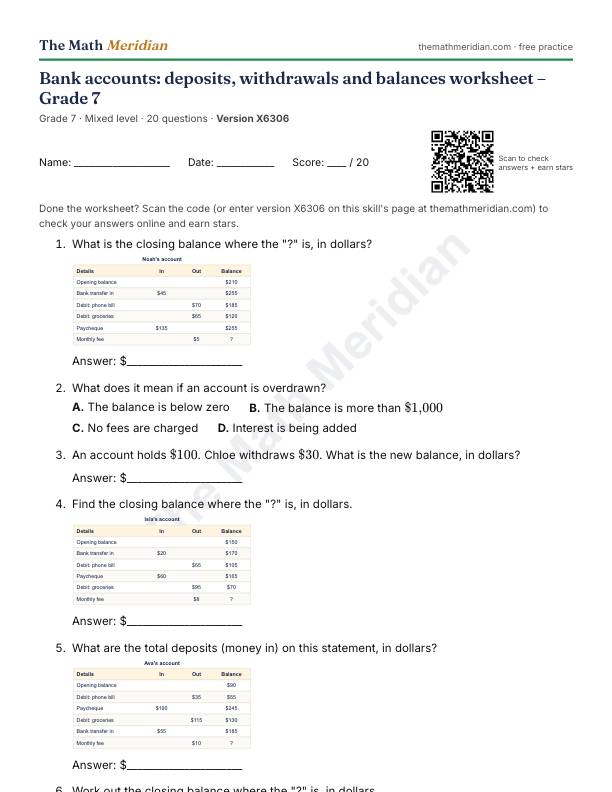
Free printable PDF: Bank accounts: deposits, withdrawals and balances worksheet (Grade 7)
20 questions from easy to hard, with an answer key on the last page. Print it, then scan the QR code on the sheet to check the answers online and earn stars.
Download the PDF worksheetWant a different version? Use Printable worksheet above for a new set of questions every time.
Worked examples: Bank accounts: deposits, withdrawals and balances
Try each one first, then open the solution.
-
Easy
An account holds $\$250$. Mateo withdraws $\$40$. What is the new balance, in dollars?
Show the solution
Answer: 210
250 − 40 = 210.
-
Medium
An account holds $\$250$. Maya withdraws $\$275$. What is the balance now, in dollars?
Show the solution
Answer: −25
250 − 275 = −25, so the account is overdrawn by 25.
-
Hard
Account A pays 2.5% a year and has no fee. Account B pays 3.5% a year and has a $\$1.00$ monthly fee. For a balance of $\$1{,}600{,}$ how much better off are you in the better account over a year?
Choices: $\$3.90$ · $\$5.00$ · $\$4.10$ · $\$4.00$
Show the solution
Answer: $\$4.00$
An earns 40. B earns 56 − 12 in fees = 44. The difference is 4.00.