Experimental probability and predictions worksheet – Grade 7
Questions at easy, medium and hard levels. Pick a level and get a fresh set every time, with instant feedback.
How to solve experimental probability and predictions questions
Learn it Experimental probability comes from data: times it happened ÷ trials. Use it to predict: probability × new number of trials.
Example: A player makes 18 of 30 shots.
- Probability: 18/30 = 3/5.
- Predict for 50 shots: 3/5 × 50.
- About 30 shots.
Loading questions…
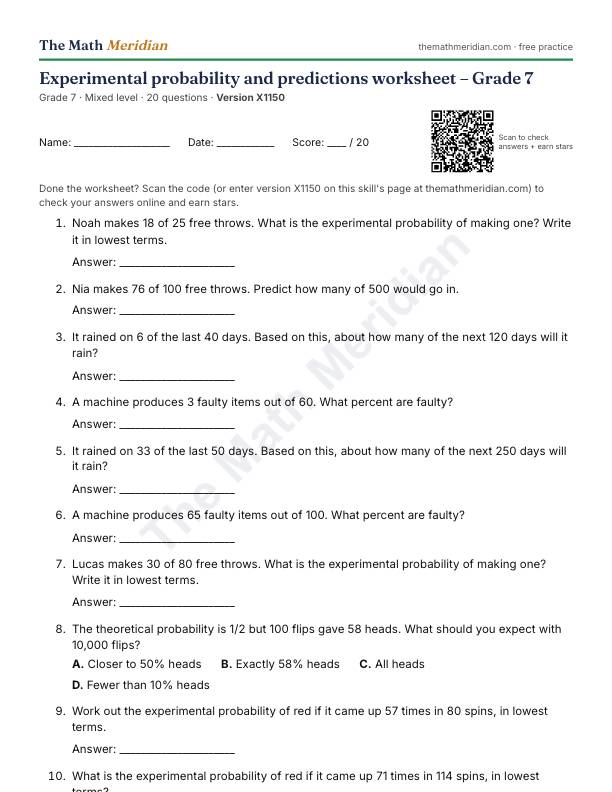
Free printable PDF: Experimental probability and predictions worksheet (Grade 7)
20 questions from easy to hard, with an answer key on the last page. Print it, then scan the QR code on the sheet to check the answers online and earn stars.
Download the PDF worksheetWant a different version? Use Printable worksheet above for a new set of questions every time.
Worked examples: Experimental probability and predictions
Try each one first, then open the solution.
-
Easy
Zara makes 10 of 25 free throws. Predict how many of 125 would go in.
Show the solution
Answer: 50
10/25 × 125 = 50.
-
Medium
The theoretical probability is 1/2 but 100 flips gave 58 heads. What should you expect with 10,000 flips?
Choices: Closer to 50% heads · Exactly 58% heads · All heads · Fewer than 10% heads
Show the solution
Answer: Closer to 50% heads
More trials usually bring results closer to the theoretical value.
-
Hard
A number cube is rolled 60 times and shows 6 twenty times. What might this suggest?
Choices: The cube may be unfair · The cube is certainly fair · 6 can never appear again · The next roll must be 6
Show the solution
Answer: The cube may be unfair
You would expect about 10 sixes, so check with more rolls.