Direct and partial variation: real-life problems worksheet – Grade 9
Questions at easy, medium and hard levels. Pick a level and get a fresh set every time, with instant feedback.
How to solve direct and partial variation: real-life problems questions
Learn it In a direct variation, y = kx: when x is 0, y is 0, and doubling x doubles y. The constant of variation k is the rate (for example, dollars per hour). In a partial variation, y = mx + b: there is a fixed amount b (like a starting fee) plus a rate m.
Example: A tap fills a tank at a steady rate. After 6 min there are 90 L in the tank. How much water is there after 20 min?
- k = 90 ÷ 6 = 15, so V = 15t.
- V = 15 × 20
- = 300 L. The constant 15 is the number of litres that flow in each minute.
Loading questions…
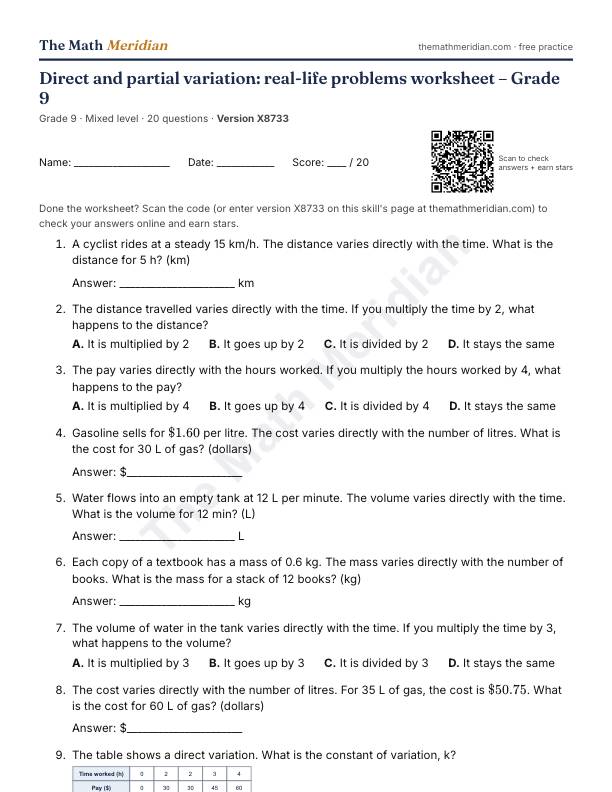
Free printable PDF: Direct and partial variation: real-life problems worksheet (Grade 9)
20 questions from easy to hard, with an answer key on the last page. Print it, then scan the QR code on the sheet to check the answers online and earn stars.
Download the PDF worksheetWant a different version? Use Printable worksheet above for a new set of questions every time.
Worked examples: Direct and partial variation: real-life problems
Try each one first, then open the solution.
-
Easy
A cyclist rides at a steady 15 km/h. The distance varies directly with the time. What is the distance for 4 h? (km)
Show the solution
Answer: 60
Direct variation: d = kt with k = 15. d = 15 × 4 = 60 km.
-
Medium
The distance varies directly with the time. For 2.5 h, the distance is 60 km. What does the constant of variation represent?
Choices: The total distance of the trip · The speed: the distance travelled each hour · The distance at the start of the ride · The time taken to ride one kilometre
Show the solution
Answer: The speed: the distance travelled each hour
k = 60 ÷ 2.5 = 24: the speed: the distance travelled each hour.
-
Hard
A plumber charges a call-out fee of $\$85$ plus $\$95$ per hour. The call-out fee goes up, but the rate stays the same. How does the graph of cost change?
Choices: It moves up, with the same steepness · It is steeper, with the same starting point · It is less steep, with the same starting point · It moves down, with the same steepness
Show the solution
Answer: It moves up, with the same steepness
The fixed fee is the vertical intercept, so the whole line moves up. The rate (the slope) is the same, so the steepness does not change.
🧰 Try it hands-on: Meridian Graph. Graph it on our free graphing calculator and drag the sliders to see how it changes.