Is it a function? Pairs, tables, mappings and graphs worksheet – Grade 8
Questions at easy, medium and hard levels. Pick a level and get a fresh set every time, with instant feedback.
Is it a function? Pairs, tables, mappings and graphs
Learn it A relation is a function when every input (x) has exactly one output (y). Outputs may repeat; inputs may not go to two different outputs. On a graph, use the vertical line test: if any vertical line crosses the graph more than once, it is not a function.
Example: Is {(1, 4), (2, 4), (3, 7), (1, 9)} a function?
- Look for an x-value that appears twice.
- x = 1 goes to 4 and to 9.
- One input has two outputs, so it is not a function. (2 and 1 both going to 4 is fine.)
Loading questions…
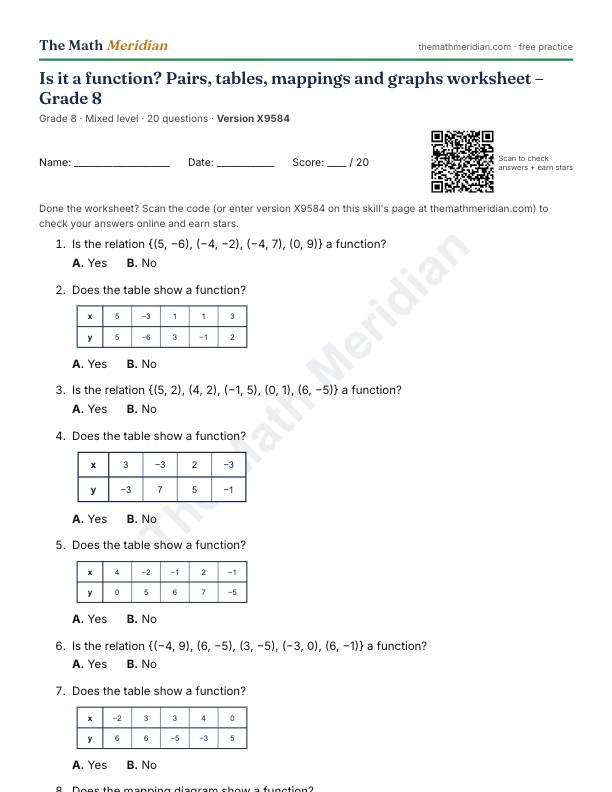
Free printable PDF: Is it a function? Pairs, tables, mappings and graphs worksheet (Grade 8)
20 questions from easy to hard, with an answer key on the last page. Print it, then scan the QR code on the sheet to check the answers online and earn stars.
Download the PDF worksheetWant a different version? Use Printable worksheet above for a new set of questions every time.
Worked examples: Is it a function? Pairs, tables, mappings and graphs
Try each one first, then open the solution.
-
Easy
Is the relation {(3, −1), (6, −6), (1, 6), (5, −1), (2, 7)} a function?
Choices: Yes · No
Show the solution
Answer: Yes
Every input appears only once, so each input has exactly one output: it is a function. (Repeated outputs are fine.)
-
Medium
Does the mapping diagram show a function?
Choices: Yes · No
Show the solution
Answer: No
The input 2 has two arrows, to two different outputs, so it is not a function.
-
Hard
Which relation is a function?
Choices: {(0, 3), (−2, 8), (5, 3), (−3, 9)} · {(6, 1), (6, −2), (2, −4), (−3, −6)} · {(0, 3), (4, 3), (2, 6), (4, 6)} · {(−2, −3), (4, 6), (6, −2), (6, 4)}
Show the solution
Answer: {(0, 3), (−2, 8), (5, 3), (−3, 9)}
{(0, 3), (−2, 8), (5, 3), (−3, 9)}: Every input appears only once, so each input has exactly one output: it is a function. (Repeated outputs are fine.) Each of the others has an input with two outputs.
🧰 Try it hands-on: Meridian Graph. Graph it on our free graphing calculator and drag the sliders to see how it changes.