Samples, bias and drawing conclusions worksheet – Grade 8
Questions at easy, medium and hard levels. Pick a level and get a fresh set every time, with instant feedback.
How to solve samples, bias and drawing conclusions questions
Learn it Before trusting a claim, ask: was the sample random, was it large enough, and was the question fair? A sample estimate is close to the truth, not exact.
Example: 60 of 200 students in a random sample walk.
- 60 ÷ 200 = 30%.
- For 1,500 students: 30% × 1,500.
- About 450 walk.
Loading questions…
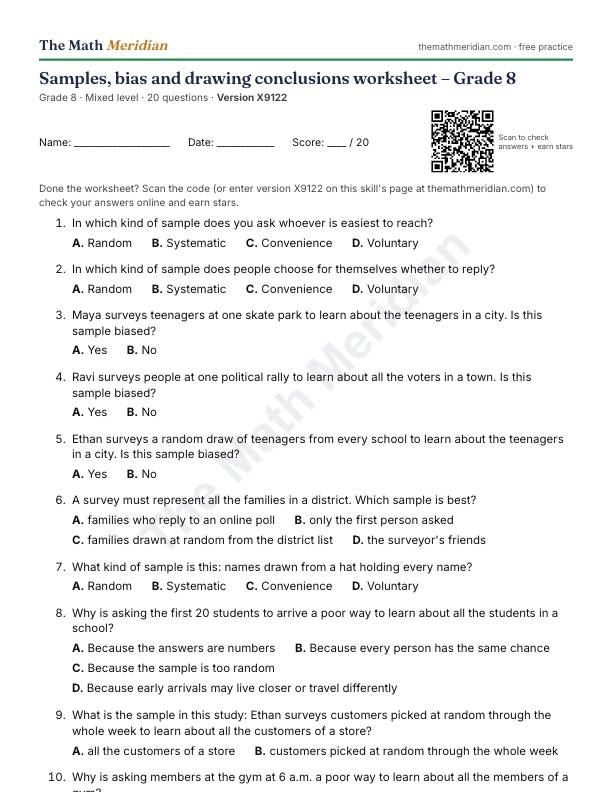
Free printable PDF: Samples, bias and drawing conclusions worksheet (Grade 8)
20 questions from easy to hard, with an answer key on the last page. Print it, then scan the QR code on the sheet to check the answers online and earn stars.
Download the PDF worksheetWant a different version? Use Printable worksheet above for a new set of questions every time.
Worked examples: Samples, bias and drawing conclusions
Try each one first, then open the solution.
-
Easy
In which kind of sample does you pick every nth one from a list?
Choices: Random · Systematic · Convenience · Voluntary
Show the solution
Answer: Systematic
That is the meaning of a systematic sample.
-
Medium
Find the sample in this study: Kai surveys every 10th member on the list to learn about all the members of a gym.
Choices: all the members of a gym · every 10th member on the list
Show the solution
Answer: every 10th member on the list
The sample is the smaller group actually asked.
-
Hard
In a random sample of 100, 20 support a plan. Estimate the number who support it among 5000 people.
Show the solution
Answer: 1000
20% of 5000 = 1000.